Most electrical problems in a shop or office give a warning before they cause a shutdown: a breaker that trips more often, a warm panel cover, an exit sign that stays dark when the power drops. The trouble is that nobody is looking for those signs until something stops working. An annual electrical inspection for a business is how you catch them on your schedule instead of in the middle of a busy day.
Here is what a yearly check should cover, area by area, and how to plan it so the work fits around your hours.
- Why a Yearly Check Pays Off
- Panels, Breakers and Connections
- Lighting, Emergency Lights and Exit Signs
- Outlets, Cords and Equipment
- Permits and Records in BC
- Planning the Inspection Around Your Hours
- Frequently Asked Questions
Why a Yearly Check Pays Off
A commercial electrical system works harder than a home system. Equipment runs for long hours, new machines and computers get added a few at a time, and tenants rearrange spaces without anyone looking at the load behind the walls. Small faults build up quietly.
A planned yearly visit turns those faults into a short list of repairs you can schedule and budget for. It also gives you a written record of the condition of the system, which helps when you talk to your insurer, plan an expansion or sell the building.
The alternative is reactive work: a call when something fails, often at the worst moment, with staff waiting and customers at the door. A regular check does not remove every surprise, but it removes the ones that were visible all along. It is the core of the electrical maintenance work we do for businesses, and it is a good starting point if the building has never had one.
Panels, Breakers and Connections
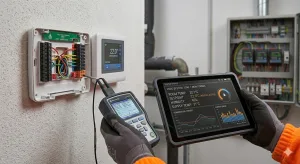
The panel is the first stop in any annual electrical inspection, because problems there affect everything downstream. We look for:
- Heat, discolouration or a burning smell at breakers and terminals.
- Loose or corroded connections, which create heat under load.
- Breakers that trip often, or that feel warm to the touch.
- An up-to-date directory, so each breaker is labelled for what it actually feeds.
- Clear working space in front of the panel, free of stored boxes and equipment.
- Signs the panel is near its limit, such as no spare spaces or doubled-up circuits.
An infrared inspection adds another layer. It shows hot spots in panels and connections that look normal to the eye, so a failing connection can be fixed before it fails.
If the check shows the service is running short of capacity for the equipment you have or plan to add, the next step is a conversation about panel upgrades. It is far easier to plan that work after an inspection than after a breaker gives up during business hours.
Lighting, Emergency Lights and Exit Signs
Lighting is easy to overlook because it usually works. A yearly walk-through catches the fixtures that flicker, buzz or run hot, and the areas that have gone dim as tubes and ballasts age. Poor lighting in stockrooms, stairwells and loading areas is a safety issue as well as a comfort one.
Emergency lighting and exit signs deserve their own attention. These systems sit idle until the power goes out, so a dead battery or a failed lamp can go unnoticed for months. During the inspection we check that:
- Exit signs are lit and visible from the paths people actually use.
- Emergency lights switch on when normal power is cut.
- Batteries hold a charge long enough to light the way out.
- Units are not blocked by shelving, signage or new walls.
Fire alarm and life safety systems can carry their own testing requirements. We confirm what applies to your building before we put it on the list.
Outlets, Cords and Equipment
Most day-to-day risk in a shop or office sits at the outlet. Over a year, workstations multiply and extension cords become permanent wiring. The inspection looks for:
- Power bars plugged into other power bars, or cords run under rugs and through doorways.
- Cracked, loose or scorched outlet covers.
- Outlets near sinks, wash bays and exterior doors, where moisture is a risk.
- Heavy equipment such as compressors, kitchen appliances or welders sharing a circuit with other loads.
- Sensitive equipment that would benefit from surge protection.
If your business relies on refrigeration, servers or a production line, the check also covers backup power. Where an outage would cost more than the fix, generator installation is worth discussing, and an existing generator should be part of the yearly look.
Shops with heavier equipment often need more than a walk-through. Our light industrial services cover the machinery and equipment side of the building.
Permits and Records in BC
For most small shops and offices, a yearly check is good practice rather than a legal requirement. Larger sites can be different. Technical Safety BC issues electrical operating permits, and the triggers it lists include a service capable of more than 250 kVA, privately owned equipment supplied at more than 750 volts, or equipment in hazardous locations. The permit exists to make sure that equipment is maintained and inspected, with records kept and available to safety officers on request.
If you are not sure where your building stands, that is part of what we look at. We check the service size and equipment against those triggers and tell you whether an operating permit applies.
Whatever the size of the business, keep the inspection report. A dated record of what was checked, what was found and what was repaired is useful for insurers, landlords and future buyers.
Planning the Inspection Around Your Hours
Some parts of the check, such as testing emergency lights, mean switching circuits off for a short time. A little planning keeps the disruption small:
- Pick a slower day of the week or season for your business.
- Tell staff which areas will lose power and when.
- Save work and shut down computers on affected circuits ahead of time.
- Clear access to panels, rooftop equipment and storage rooms.
- Have a list ready of anything that has been acting up.
We agree the scope and timing with you in the quote, so you know which areas we will check and when.
Rooham Electric is a licensed electrician working with shops, offices and light industrial businesses in Kamloops, Sun Peaks and Tobiano. If your building has not had a full electrical check in the last year, or you have never had one, we can plan one with you and give you a clear list of what we find. Visit our Kamloops electrician page to get in touch and book your inspection.
Frequently Asked Questions
How often should a business have its electrical system inspected?
Once a year is a sound habit for most shops and offices. Busier sites, older buildings and those with heavy equipment may benefit from more frequent checks of key equipment.
Is an annual electrical inspection required by law for a business in BC?
Not for most small businesses. Sites that hold an electrical operating permit from Technical Safety BC, such as those with a service over 250 kVA, must keep their equipment maintained and inspected, and we can tell you whether yours is one of them.
Will the inspection shut down my business?
Usually not for long. Only some tests need a circuit switched off, and we plan those with you so the affected areas and times are known in advance.
What is an infrared inspection?
It is a heat scan of panels and connections that shows hot spots the eye cannot see. A hot spot usually points to a loose or overloaded connection that can be repaired before it fails.
What affects the cost of a business electrical inspection?
The size of the building, the number of panels, the amount of equipment and whether an infrared scan or emergency lighting test is included all shape the price. We quote it once we know the site.
What happens after the inspection?
You get a list of what we found, ranked by urgency. Safety issues come first, and the rest can be planned into your budget and schedule.